

From Vision to Reality
Having owned a bike since 1982 and taken my wife out for a ride on it whilst we were at college together, this bike meant a lot to me – I was emotionally involved 😊.
One evening, about 12 years ago, I sketched out my vision of how I would like this motorcycle to look: a rough idea on paper but a crystal clear one in my mind. You could describe this as a low fidelity prototype!
A low-slung minimalist bike — but powerful!
After years of use, this vision was the next iteration of bike that had already been re-incarnated back in 1990, but it needed it again. This time it would be built on the adage:
Right tool — right job.
Using all the tools of a business analyst wouldprove to be a critical factor. Surprised? You shouldn’t be. The parallel to business analysis is strong, that’s why we build a toolkit, right tool, right job, right?
Why Business Analysis Tools?
People often think of business analysis as a discipline is reserved for vast corporate organisations; the truth is far from it. These same business analysis tools are just as useful for small businesses or even personal projects.
They help transform ideas into actionable steps, to keep you focused and use the appropriate amount of time and effort — therefore saving money.
Step One: SWOT Analysis
Before I even lifted a spanner, I ran a SWOT analysis.
Strengths:
- The knowledge I’d acquired on previous projects
- The network of people I knew with various skills
Weaknesses:
- Gaps in my skill set
- Budgetary restrictions
Opportunities:
- Innovative design
- Environmental compliance
Threats:
- Change in manufacturing, no access to original parts
- Change to legislation, no longer compliance on public roads
This gave me a realist’s view of the journey ahead. Whether you’re working in the office or the garage, clarity is half of the battle.
Step Two: Prioritise with MoSCoW
I had a long list of things to achieve with the bike, ranging from aesthetic touches to performance upgrades. I needed to prioritise. I needed to employ a different business analyst’s tool – MoSCoW:
- Must-haves: Reliable engine and electrics, stiff frame
- Should-haves: Powder-coated finish or 2-pac paint
- Could-haves: Automatic chain tensioner, indicators, mirrors
- Won’t-haves: Digital display, fuel injection
Without this framework, I may have either: become overwhelmed by all the choices available (leading to indecision) or gone over budget. MoSCoW kept the build realistic and doable.

Step Three: Create a Value Stream
I created a value stream to outline every stage of the build (from disassembly to test ride). This helped me organise tasks in an efficient and logical manner that would highlight everything that needed to be accomplished in each stage.
Process maps were created to show how each stage of the value stream would be delivered. These techniques are included in our business analysis/architecture courses: process mapping doesn’t just show you what to do, it also shows you how to do it and reveals the most efficient way to execute the tasks.
Step Four: Identify your Stakeholders
This wasn’t going to be a one-man build, there were stakeholders aplenty… parts suppliers, an engineer, welder, auto-electrician, carburation specialist and a painter. Oh and a few mates who were always will to give ‘helpful’ advice.
I mapped out their influence and my expectations, to create a clear and timely communication plan – this really helped to avoid delays as everyone knew what their role in the project was… RACI. This might seem excessive, but when there are so many moving parts, understanding the work and maintaining the right work-in-progress balance, depends on good communication, good relationships and clear understanding. It made such a difference!
Step Five: Plan for Risks
Before running into problems, I tried to predict where snags might appear, risk identification: late parts, wrong measurements, over expensive choices, build quality to name a few.
Using a risk matrix to identify the most likely and most costly issues, I was able to put in place mitigation strategies. Having proactive growth mindset saved me time and money.
Prototyping: The Value of Testing
Mocking up several components saved both time and money, even completing a full dry build before paint and final assembly. The handlebars, exhaust routing and seat position were all tested using temporary mounts or cardboard templates. That feedback loop with the customer (me), a staple in design thinking, meant I could fix problems cheaply and early with any specialist contributing to the project.
The Result: Vision Realised
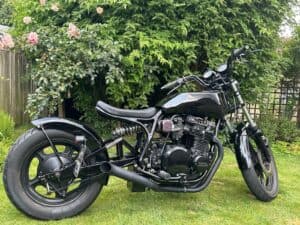
That original sketch? It’s now a fully built, fully functioning custom bike. Black, 903cc that turns heads wherever it goes. Both aggressive and elegant, it’s proof that a dream, plus a plan, can equal reality.

What You Can Take From This
The tools I used aren’t exclusive to motorcycles or businesses. They’re universal. Whether you want to write a book, build a campervan, start a podcast or launch a side hustle — business analysis tools for personal projects give structure to your ideas.
Final Thoughts
The build taught me as much about myself as it did about mechanics. I learned to think clearer, plan better and trust the process. Mistakes were made naturally, however they were manageable as many of them had been anticipated.
Best of all, I didn’t just finish a bike. I proved that good planning works in business and in life.
This wasn’t just a mechanical project. It was a mindset project. And if you’ve got a dream of your own, the right tools can take it from sketchbook to showroom.
Curious how business analysis could help you bring your own ideas to life? Get in touch — or explore our self-study BA toolkit and start building your vision today.





Leave A Comment
You must be logged in to post a comment.